The Dating Djinn blog
Ethical Catfishing Examples: Real Hobbies, AI Photos
A hike, a first skydive, a beach-house weekend, an afternoon wakeboarding. Four ways to turn missing photos of your real life into a more interesting dating profile.
Your phone has a picture of a restaurant menu from three years ago. It has a receipt you no longer need. It has fourteen attempts to photograph the moon.
What it apparently doesn't have is a useful record of you enjoying your own life.
Ethical catfishing with Photomaxxer means using AI-generated photos that represent your true self, including your hobbies and special occasions. The point is to give the things you actually do a place in your dating profile.
Here are four situations where that makes sense. Each fills a different gap, so you can choose the one your own photos are missing.
The hiker who's always behind the camera
You got up early, packed water, and walked uphill long enough to reconsider several life choices. At the top, you took a beautiful picture of the view.
Of course you did. You were standing in front of it. Nobody was standing in front of you.
Now your dating profile has to take your word for the whole “I like hiking” thing. An AI hiking photo can show that interest with you actually in the scene.
Choose familiar terrain and a believable moment. A trail break or a viewpoint can do the job. You don't need to upgrade a weekend walk into a mountaineering expedition.
This kind of picture gives someone a sense of how you like to spend a free day. It might also invite a useful question about a favorite route or the next place on your list.
The skydiver hidden inside the equipment
You jumped out of a plane. That's a fairly substantial thing to do with an afternoon.
The photos mostly establish that helmets, goggles, and harnesses exist. Somewhere inside all of that is you, but your prospective matches may need a diagram.
A generated skydiving scene can represent the experience while giving your face a fighting chance. Pick something that fits what you actually did, whether that was a first tandem jump or part of a regular hobby.
Let the experience supply the story. You don't need to invent expertise to make trying something memorable worth showing.
And don't treat the generated image as a recovered frame from the original jump. It's a new photo representing that experience. The real story is already interesting enough.
The beach-house trip documented entirely by the group chat
Your friends finally booked the beach house. Everyone made it. The weekend was excellent.
The camera roll contains the rental address, the grocery list, and a photo of the living room you took to prove you cleaned it. A comprehensive administrative record of having fun.
A generated vacation scene can show the relaxed, social side of that experience. Choose something that feels like the kind of trip you take, with clothes and a setting that make sense for you.
You should still be easy to identify. A social photo isn't much use if someone has to hold an investigation to work out whose profile they're looking at.
The picture's job is to suggest what spending time with you could feel like. It doesn't need to imply that you own the house, or that a generated background person is one of your actual friends.
The wakeboarder with an entire camera roll of spray
Your friends did take pictures this time. Unfortunately, they captured every splash in impressive detail and your face in none.
Being photographed while moving across water turns out to require more effort than pointing a phone vaguely toward the noise.
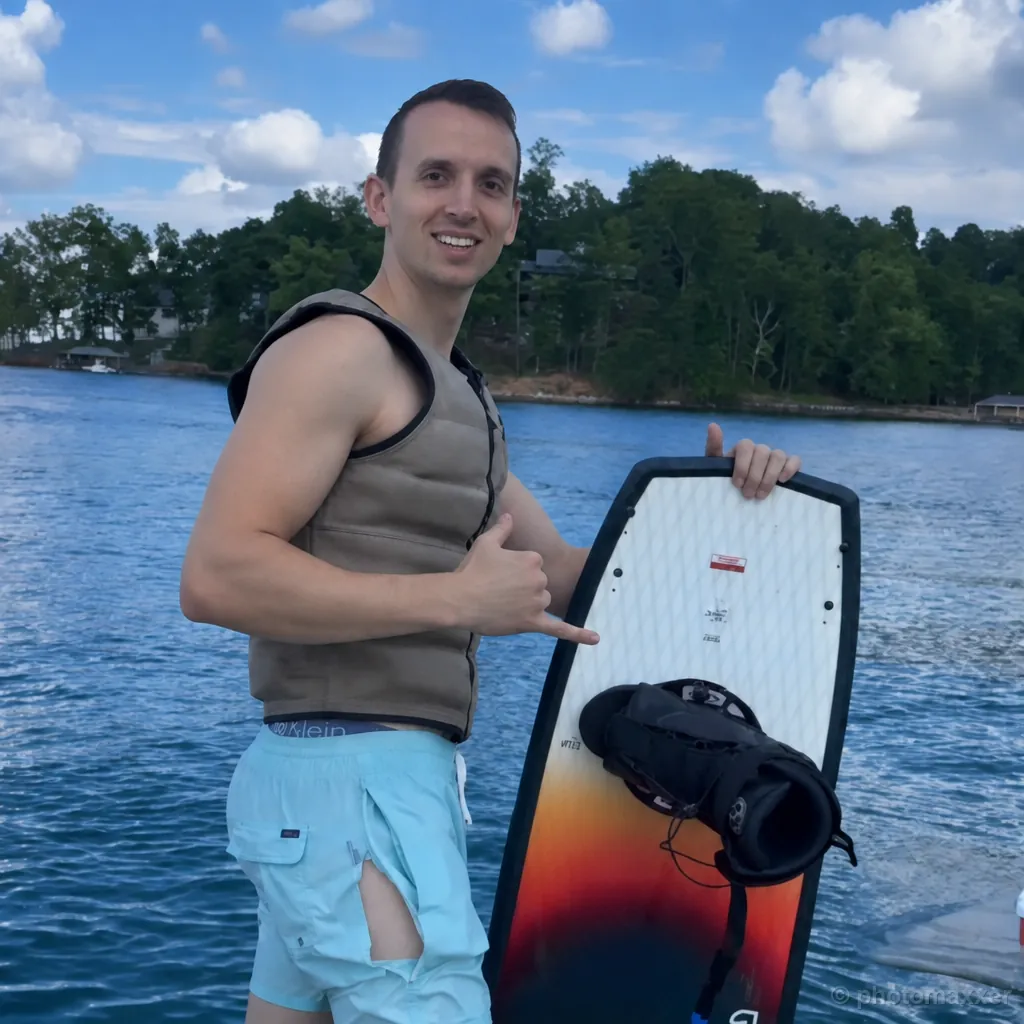 AI Generated
An AI wakeboarding photo can show the hobby in a quieter moment. Holding the board between runs might tell the story more clearly than an action shot where nobody can recognize you.
Match the scene to your experience. A regular afternoon on the water is enough. The template doesn't need to turn you into a professional doing a trick you've never attempted.
This is also why the most dramatic image isn't automatically the best profile photo. The useful result shows both the interest and the person someone might meet.
Choose the missing part of your life first
Before browsing templates, look at your current lineup. Write down what someone could actually learn from each photo. If the same answer keeps coming up, you've found space for something different.
Pick one interest or experience that belongs in that space. You can browse Photomaxxer examples with that purpose in mind, instead of collecting every scene that looks impressive.
Use clear, current reference photos. Check the face and build in the results, then look at the new image beside the ones you're keeping. Does it resemble you? Does it add anything? Would you be comfortable talking about the activity or occasion?
For the definition, read what ethical catfishing means. For the Hinge angle, see five reasons to give your Hinge profile AI photos of your real life.
Make the pictures your profile is missing
Photomaxxer generates AI dating photos from your reference images. Choose Enhanced, add four reference photos, and select scenes that fit the interests and experiences you want to show.
You already have things going on. Give someone looking at your profile a chance to notice them.