Dating Profile Photos With Women: Keep the Context Clear
Keep the shared moment easy to understand.
You can include photos with women on your dating profile. Choose a shared moment where the occasion and your place in it are easy to understand. A lively wedding scene and a tightly framed couple portrait tell different stories, even if both include the same number of people.
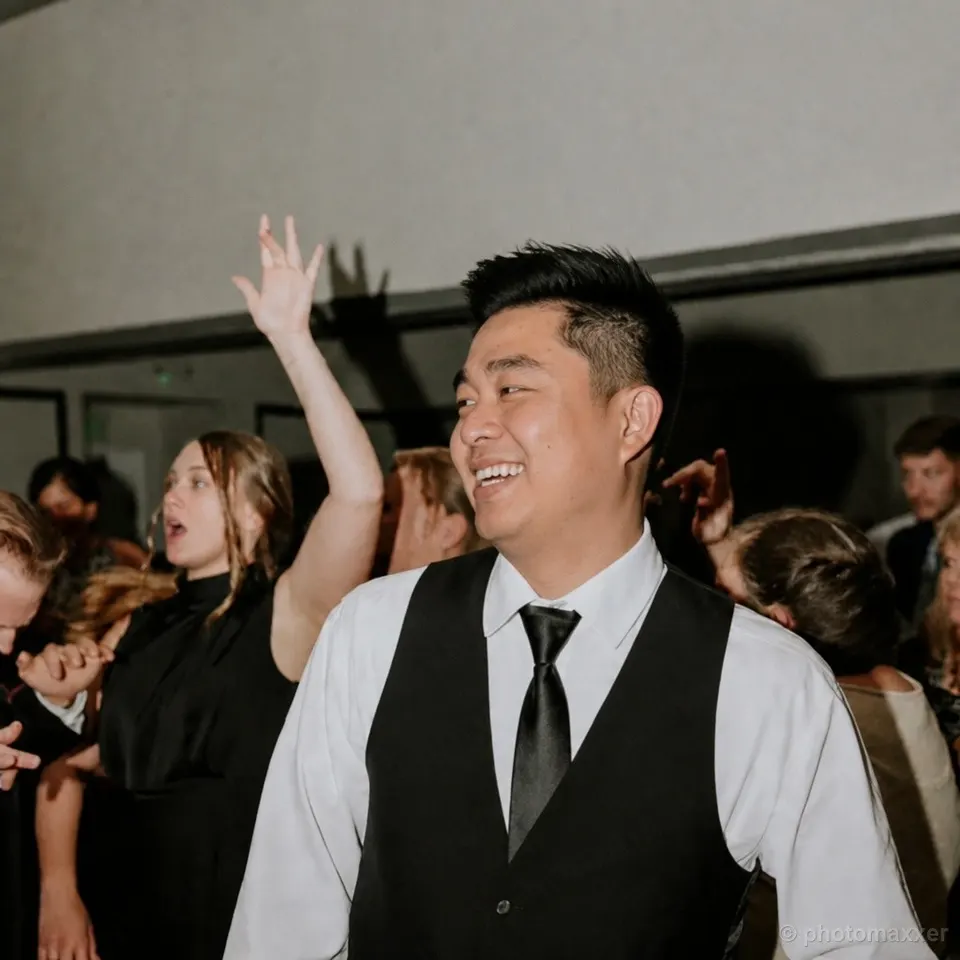
Let the occasion explain why people are together
Jason's wedding photo shows a celebration in progress. His broad smile, the raised hand and the other guests give the scene energy. The people around him help explain the moment. Removing every woman from the frame would strip away part of that social setting.
You don't need to establish each guest's relationship to him to understand this picture. It works as a glimpse of an occasion and his expression within it. That's a useful starting point for your own photos: can someone understand what is happening before you explain who everyone is?
Look for a shared activity, a celebration, a conversation or a clear gathering. The scene should give the photo a reason to exist beyond the fact that women are nearby. The wedding-photo guide has more examples of moments that carry their own context.
Check whether the framing suggests a couple
A close two-person portrait with an intimate pose can leave a different impression from a wider group enjoying an event. That doesn't prove the people are dating. It does mean a stranger has less context for understanding the relationship.
Read the picture without the explanation you'd give a friend. If its main story seems to be “us as a couple,” look for another frame that shows the actual occasion more clearly. A wider group, an activity in progress or a less intimate pose may give you the social moment without making the relationship the central question.
This applies whether the person is a friend, a sister, a colleague or an ex. Choose based on what the picture communicates and whether it fits your current introduction. Don't invent a relationship label to make a confusing photo easier to use.
Would the scene make sense without a backstory?
- Read the setting
Can someone see the activity, gathering or celebration?
- Check the framing
Does it show a shared occasion or mainly suggest a couple portrait?
- Keep the useful moment
Choose the frame that adds warmth, company or personality.
If the relationship needs a long explanation, try a clearer photo.
Don't mistake proximity for connection

In Jason's venue photo, the central pose is with the man beside him. A woman is also visible near the edge, and more people fill the room. The picture shows a busy night out; it doesn't establish his relationship with every person in view.
That's why counting women in a frame is a poor way to choose a dating photo. Ask what you're visibly doing with the people around you. Shared attention, a relaxed pose or a reaction to the same moment gives you something concrete to evaluate. Someone simply passing through the background doesn't do the same job.
In Photomaxxer's framework, Popularity is about the impression of social connection and being welcome in company. A woman standing nearby doesn't automatically supply it. Status is a separate idea involving achievement, authority or a meaningful role. Neither trait comes from using other people as props.
Keep a nightlife picture because it shows a kind of time you'd enjoy sharing. If it mainly adds a crowd and repeats another night out, a different social moment may tell the profile reader more. The group-photo guide helps you judge that contribution.
Use a short explanation only when it adds something
If a relationship needs clarifying and the profile gives you room, a brief factual line can do it: “My sister's graduation” or “With my climbing group.” Use the actual relationship and occasion. You don't need a defensive paragraph about everyone in the image.
A line like “Relax, she's just a friend” puts the reader into an argument they haven't started. Keep the wording about the moment instead. If you keep feeling the need to defend the photo, choose another one that introduces you more easily.
For a picture with an ex, ask whether the frame still works as a current, independent introduction. A tight romantic portrait is usually a poor candidate. Cutting a person off at the shoulder or covering their face can leave the relationship as the most noticeable thing about the image. A different photo is often the cleaner choice.
Keep ordinary company in the mix

MJ's dinner photo offers another kind of social setting. He's prominent in the frame, but the nearby people and tables make it feel like a gathering. The useful impression comes from his expression and the occasion; you don't need to identify every guest to see that.
Photos with women don't all have to come from parties. A meal, shared hobby or daytime gathering can give someone an appealing sense of your company. Choose the moment that fits your life and brings something the other pictures don't already show.
Then check the whole profile. Can someone recognize you across the images? Is there a range of activities and expressions? Does the social picture complement the others, or does every frame leave the reader sorting through relationships?
Keep the photos that make meeting you easier to imagine. You don't need a quota of women, men or group shots, and you don't need every trait in every image. Use a clear social moment where it adds value, then let the rest of the lineup show other sides of you.